
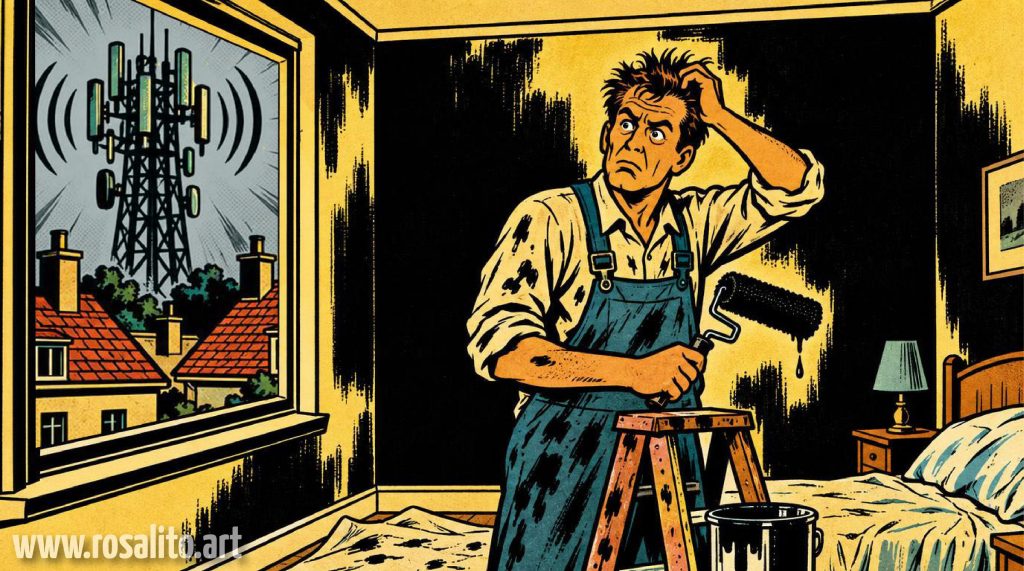
Measure Before You Do Anything Else
Before choosing paint, fabric, metal or any other shielding material, you first need to establish what you are actually trying to reduce.
Which frequencies are present? At what field strengths? Under what conditions? And which sources are actually contributing to the exposure?
Without a proper RF assessment, you risk choosing a shielding solution without knowing whether it is appropriate for the problem you are trying to solve.
Your first investment should therefore not be in shielding materials, but in a proper RF assessment. This is precisely what this article aims to explain.
DIY Measurements vs. a Professional RF Assessment
There are now a wide range of devices that allow consumers to measure radiofrequency (RF) fields. They can be very useful for discovering and better understanding the electromagnetic environment around you.
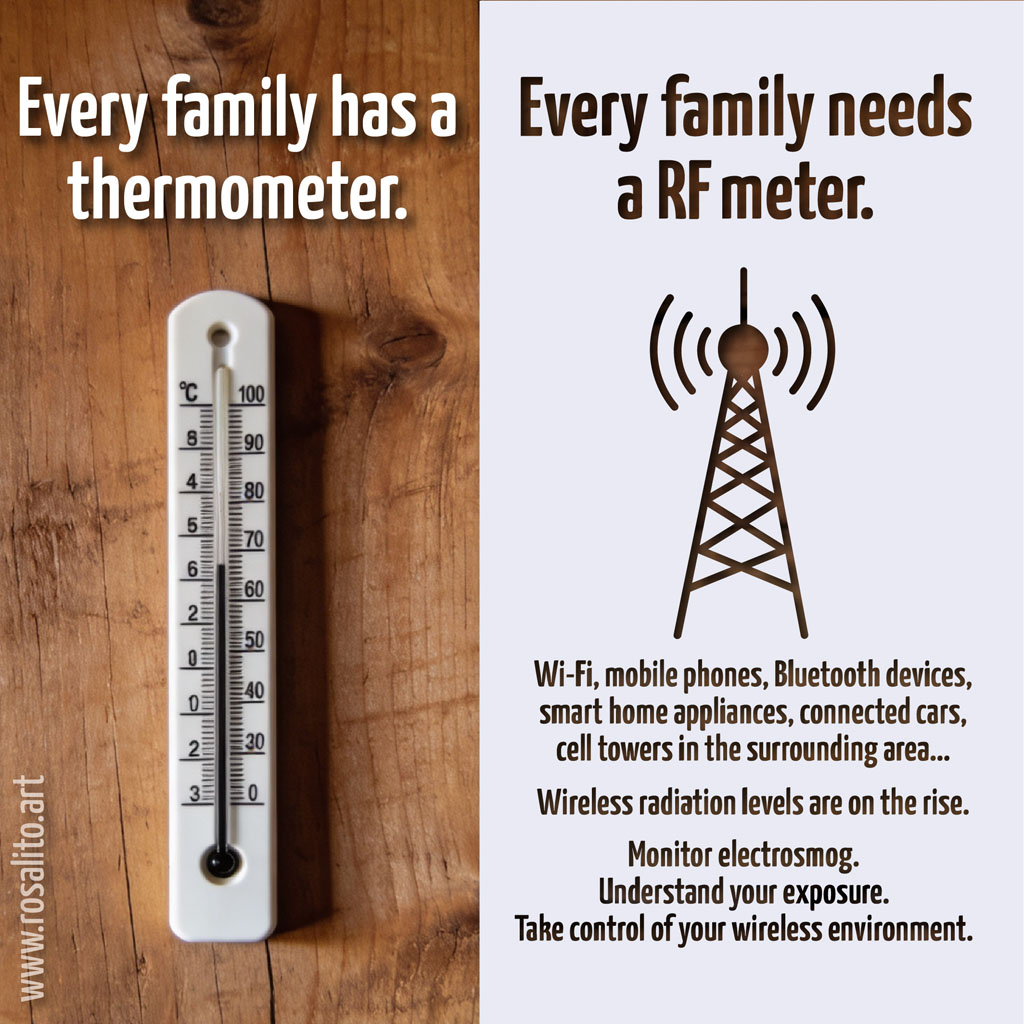
I encourage everyone to get a personal EMF meter and learn how to use it on a daily basis. This can significantly reduce our exposure by adopting habits and practices that emit as little radiation as possible, and by making the best choices when it comes to connectivity. The meters I use are presented on this page.
However, these devices cannot be compared with professional equipment, neither in terms of capabilities, accuracy nor complexity of use. If I were to shield my own home, I would not consider my own meters sufficient for the job.
And having a meter does not make you a professional assessor.
A private individual will inevitably have only a partial view of the situation. A competent professional knows what to measure, which meters to use, under what conditions, according to which protocol, how to interpret the results, and, most importantly, what conclusions to draw from them and what to do next.
This is an essential distinction: having a meter does not necessarily mean knowing how to carry out an assessment.
You May Be Trying to Shield Against One Antenna, but radiation Can Come from Anywhere
You may think that you need to protect yourself from one specific source: “There’s a cell tower near my home, so I’m going to shield my bedroom.”
But the electromagnetic environment inside a home is rarely that simple.
Radiation can come from outside, but also from neighboring homes, from the floors above or below… and from inside the home itself.
We often have no idea how many transmitters we may have in our homes, or even on our person.
The assessment must therefore take into account the actual RF environment of the space, rather than focusing solely on the source that was initially identified.
Conductive Materials Bring Electrical Considerations into the Equation
This is a crucial safety issue that is often overlooked.
The materials used for RF shielding are generally conductive. Their installation therefore cannot be treated as a simple decorating job.
The existing electrical installation, connections, grounding, and any possible interactions between the shielding and the building's electrical systems all need to be taken into account.
A conductive material introduces an electrical dimension to the project. And that is not a minor detail.
This is one of the reasons why RF shielding should not be designed from an RF perspective alone: the RF aspects and the electrical safety aspects need to be addressed by people with the appropriate expertise. The person responsible for the shielding work must also ensure that its installation does not create electrical safety issues.
Poorly Designed Shielding Can Make Things Worse
A poorly designed or improperly installed shielding system can have defects that significantly compromise its effectiveness.
In some situations, the result can even be very different from what was intended, due in particular to installation defects or interactions with the electromagnetic environment and the electrical system.
Doing “something” is not necessarily better than doing nothing.
This is precisely why shielding should be designed based on an assessment and then verified through measurements.
Removing Shielding Can Be Difficult and Costly
This is a very practical point that people rarely think about when following a tutorial.
If the project fails, you may have to remove the shielding, take down certain components, redo connections, and restore the surfaces to their original condition.
This can turn into an even bigger and more expensive project than the original installation, on top of the time and money already spent on a failed shielding project.
Before getting started, it is therefore better to be sure about your project.
It is easy to paint. It is not so easy to “un-paint.”
Tutorials Are Not a Substitute for Expertise
Yes, you can find tutorials explaining how to apply conductive paint or install different shielding materials.
They can be useful for understanding the general principle.
But without a solid understanding of electromagnetic pollution, shielding materials, and electrical systems, it is very easy to reproduce the steps shown in a video while completely missing the actual problem.
A tutorial shows you a method. It does not tell you whether you are using the right product, in the right place, for your particular situation.
Most importantly, it does not carry out the assessment for you.
So, How Do You Find Someone Who Really Knows What They’re Doing?
With demand growing, more and more people are offering electromagnetic field assessments. But there are major differences between a “geobiologist” who arrives with a pendulum and relies on subjective impressions, a motivated amateur with several consumer meters, and a properly trained and equipped professional.
It is worth being cautious about approaches that rely primarily on esoteric practices. Everyone has their own area of expertise: electromagnetic fields should be characterized using appropriate detection and measurement instruments, following a suitable methodology.
Before choosing a professional, ask them in particular:
- What training and experience do they have in RF and electromagnetic field measurements?
- Which meters do they use exactly? Ask for a list of the equipment they use and the frequency ranges it covers.
- What exactly does the assessment include? What measurements will be taken, in which rooms, and under what conditions?
- What will the report contain? The measurements should be documented and the conclusions clearly explained.
- What kind of recommendations will be provided? The assessment may result in a technical report that you can then use when consulting a company to carry out the work.
- Do they provide follow-up and verification after the work? A new round of measurements can be used to verify the result that has actually been achieved
Assessment, Recommendations, Installation and Verification: Who Does What?
There are several ways to approach an RF shielding project.
A professional may carry out the assessment only, then provide a report and technical recommendations.
They may also help design the shielding system and, if they have the necessary skills, carry out the work themselves.
Finally, they may provide or offer a post-installation verification phase, with further measurements to check the performance achieved and, if necessary, identify areas that need to be corrected.
These different stages can therefore be handled by one person or by several professionals, with some of the work also carried out by you, depending on your skills.
What matters is being clear about what falls under the assessment, recommendations, installation, and verification stages.
A serious professional should be able to explain their approach, the limits of each service they provide, and how the results will be verified, without asking you to take their word for it based solely on a sales pitch.
In Summary
The Steps in an RF Shielding Project
A proper RF shielding project does not start with buying a material. It follows a series of steps, each with a specific purpose:
Assessment → Recommendations → Installation → Verification
Assessment
Measure and characterize the electromagnetic environment of the space in order to identify the sources of exposure, where they are coming from, and the levels involved.
Recommendations
Based on the assessment, define the RF shielding strategy: materials, technical solutions, target attenuation level, and constraints related to the building and its installations.
Installation
Implement the selected solutions while respecting the technical requirements of the RF shielding project, the specific constraints of the space, and its electrical configuration.
Verification
Measure again after the installation to verify the performance actually achieved and, if necessary, identify any areas that need to be corrected.
These four steps can be carried out by one professional or by several people, with some of the work also done by you. The important thing is not to skip any of them.